Arts & Crafts (1880–1915)
Era Snapshot: Emerging in the late 19th century as a response to industrialization, the Arts & Crafts movement emphasized craftsmanship, natural materials, and the intrinsic beauty of handmade objects. Rooted in the ideals of designers such as William Morris, this period sought to restore integrity to decorative arts through thoughtful design and skilled execution.
Objects from this era often feature organic forms, stylized florals, and a restrained yet intentional use of decoration, with an emphasis on surface quality and material authenticity. Pottery, metalwork, and decorative objects reflect a balance between function and artistry, favoring simplicity over excess.
Within this broader movement, related styles and cultural influences emerge that further enrich the period.
Art Nouveau (c. 1890–1910) introduces a more fluid and expressive visual language, defined by sinuous lines, asymmetry, and motifs drawn directly from nature. Designs often appear to move and grow organically, with flowing forms that blur the line between structure and decoration.
At the same time, the Belle Époque (c. 1870–1914) reflects a cultural moment of optimism, refinement, and artistic flourishing, particularly in France. Decorative objects and sculpture from this period often convey elegance, romanticism, and a heightened attention to detail, capturing the spirit of a society deeply engaged with art, performance, and beauty.
Together, these influences create a richly layered period in which craftsmanship, artistic expression, and cultural sophistication converge. Today, works from this era are valued for their authenticity, refined design, and their role in shaping the transition from traditional craftsmanship to modern artistic identity
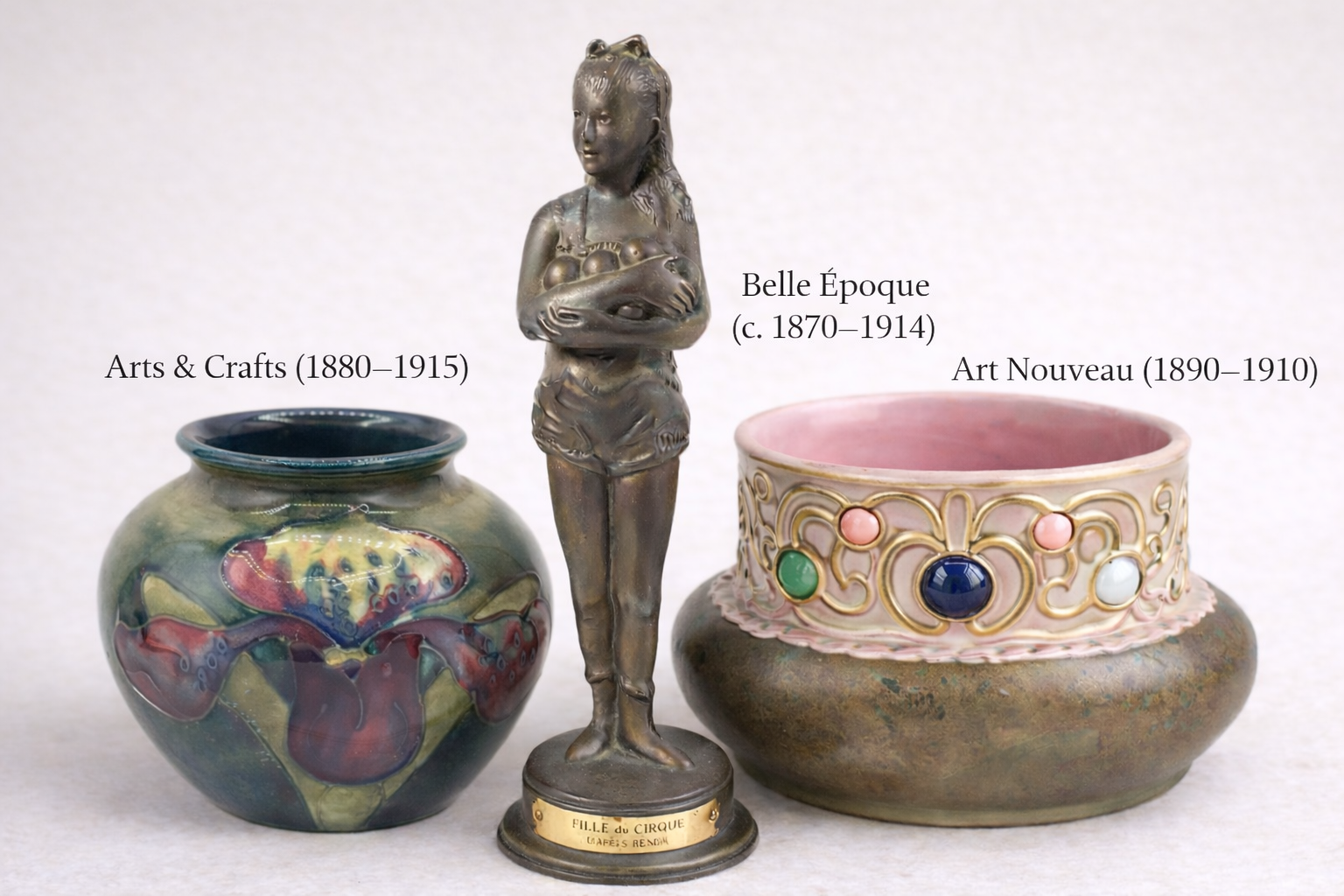
Arts & Crafts (1880–1915) –
Moorcroft “Iris” Pottery Vase
The Arts & Crafts movement emphasized handcrafted design and artistic craftsmanship. Moorcroft pottery became famous for its tube-lined floral designs and rich glazes, making it one of the most celebrated art pottery traditions of the early 20th century.
Belle Époque (c. 1871–1914) – Classical Figural Sculpture
The Belle Époque celebrated elegance, refinement, and classical inspiration across the decorative arts. Sculptural works from this period often feature idealized human forms, graceful proportions, and a sense of quiet luxury, reflecting a time of cultural optimism and artistic flourishing in Europe.
Art Nouveau (1890–1910) – Enamel & Metal Decorative Vessel
Art Nouveau design is defined by flowing lines, organic forms, and inspiration drawn from nature. Decorative metalwork from this era often incorporates enamel, gemstones, and sinuous motifs, creating harmonious, sculptural objects that blur the line between function and art.